Why Is My Cat Standing Up On Two Legs?
Upright Felines: Decoding Why Cats Sometimes Stand on Two Legs
Table of Contents
- 1 Upright Felines: Decoding Why Cats Sometimes Stand on Two Legs
- 2 Unpacking the Behavior: Delving into Why Cats Stand Tall
- 3 Instinct and Defense: Reasons Behind the Upright Stance
- 4 Physical Factors: Health and Ability to Stand Upright
- 5 The World Around Them: How Environment Influences This Behavior
- 6 Seen in Art: The Upright Cat in Creative Expression
- 7 Cultural Claws: The Significance of Upright Cats
- 8 Conclusion: Appreciating the Upright Cat Behavior
Cats are intriguing animals, and their behavior can be puzzling sometimes. This includes the strange behavior of standing on their two back legs. Even if not associated with cats, this quirky behavior can throw cat owners for a loop when a somewhat normal cat suddenly stands up like a little biped. One might wonder if the behavior is for simple fun or if it is instinctual or environmental. Many cat owners have seen their cats stand on two legs. But why? To understand this behavior, you should consider their instincts and environment. What’s going on here? So, let’s look into the interesting behavior of cats standing on two legs.
Unpacking the Behavior: Delving into Why Cats Stand Tall
To comprehend why cats exhibit bipedal behavior, we have first to discuss some unremarkable observations about cat behavior. With their playful and curious nature, cats can be quite entertaining to watch. From a minor flick of a tail to sometimes standing on their hind legs, you can learn a lot from watching a cat in these positions.
Additionally, cats are natural solitary hunters, blending innate and learned behaviors. A cat continuously searches for threats and opportunities to play and act exploratively. The set of behaviors arranged on a continuum towards innate and non-instinctual behaviors is complicated at best. The behaviors that shape how a cat acts are not arbitrary; they stem from the course of evolution for the individual cat and in determining what is good for their species. It is crucial to understand the cat’s experiences, this complexity, and why a cat would stand up on its hind legs to connect with your pet truly.
Curiosity and Exploration: A Better Vantage Point
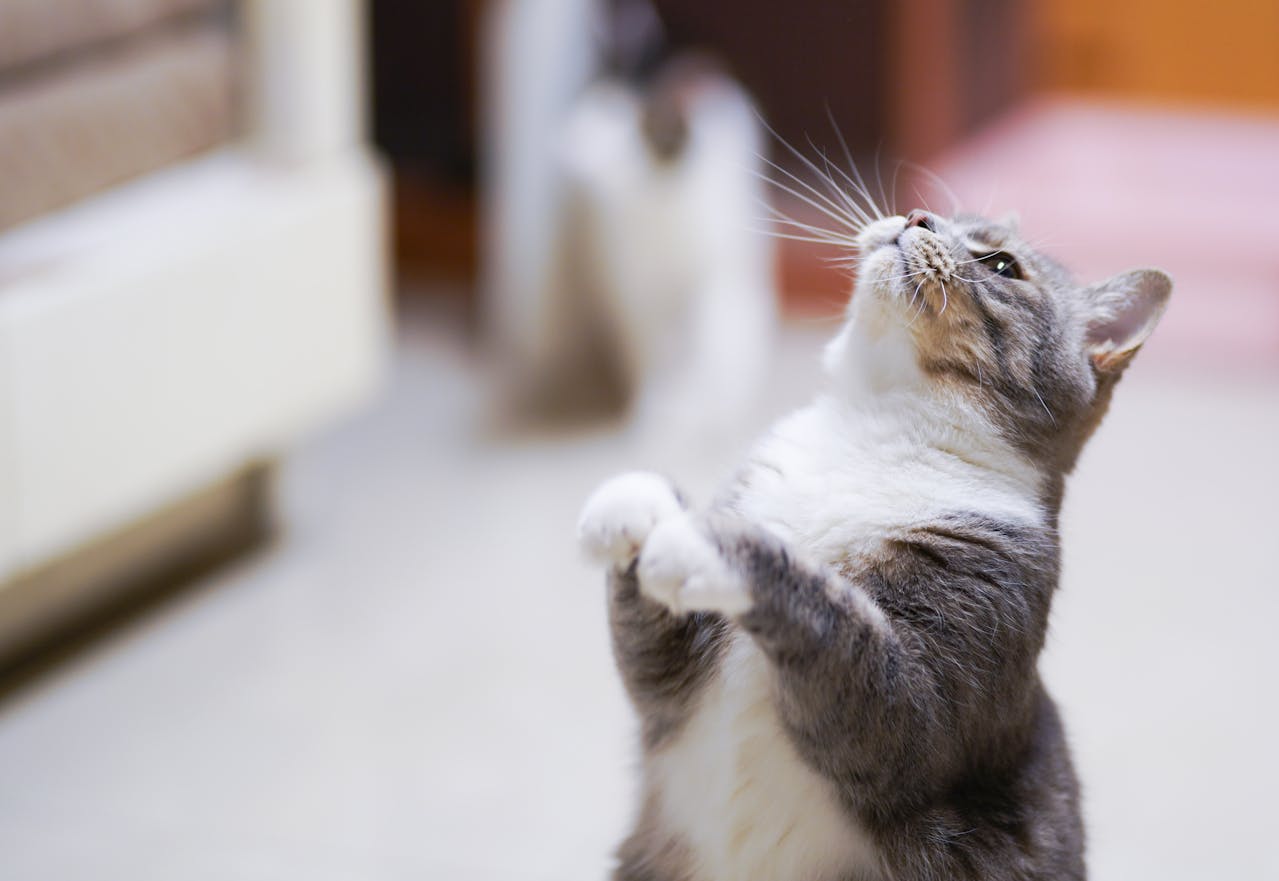
Cats are no strangers to curiosity. When a cat stands on its hind legs, it tries to get a better view of the object of interest, similar to a human standing on tiptoes to see over a crowd. Cats can also stand on two legs to see over furniture, look out of a window, or investigate a sound; it is one way for a curious cat to gather more information about its surroundings.
Standing tall gives them a clearer view of their surroundings, an important safety issue for cats’ well-being. Standing tall gives cats more information about their environment; cats can locate the source of a sound or see a fluttering bird from the window. This emphasizes the importance of cats constantly evaluating their environment to remain aware of any changes or intrusions into their territory. Similarly, in a home context, a cat can attempt to interact with its human companions, who may be enjoying the taste or activity the cat is unaware of.
Playful Postures: Engaging in Upright Fun
Another reason cats might stand on their hind legs is playfulness. When cats play with their toys or other animals, they take on many playful positions. Standing on two back legs can be part of a playful posture, making them appear larger or more threatening during playfighting. Standing on two legs lets them swat toys or objects with their first paws.
This is especially common during an interactive play session, when a cat may stand on their hind legs before jumping at a toy or when playfighting with another pet. The standing position allows them to use their paws together during play. The upright position also mimics the natural hunting style of wild cats and enables them to practice and develop their hunting skills in a safe environment. This behavior is adorable and is likely enjoyable for both the cat and the human.
Instinct and Defense: Reasons Behind the Upright Stance
Curiosity and playful behavior are two common reasons for this behavior, but instinctual and defensive factors are in effect. Cats have developed a range of behaviors to help them manage the complexities in their world, ensuring their survival and welfare.
Defensive Mechanisms: Gaining Height in Threat Situations
When a cat feels threatened, it may stand on its hind legs to appear larger and more dangerous. This is usually paired with other indicators of aggression or fear, such as a puffy tail or an arched back. These cats hope to scare away a predator or threat by looking larger.
This defensive body posture is a carry-over from their ancestry in the wild, as looking larger could be the difference between life and death. Within a domestic context, this body posture can be instigated by sudden movements, strange sounds, or the presence of a perceived threat, like another animal. It reminds them of their survival instinct, even while cozy in the comfort of a home. Watching a cat adopt this body posture may give clues as to what might be causing your cat stress or anxiety.
The Role of Instincts: Inherited Behaviors at Play
Cats are the offspring of wild creatures that rely on their senses to survive in the wild. Standing on two legs may also be an instinctual behavior passed down through generations. It may have allowed a cat to see potential threats or prey from a distance in its natural habitat.
This behavior is programmed into their DNA, a survival behavior passed down through generations. It does not matter that the domestic cat is sheltered from the wild; their instincts are still present. These behaviors are just one aspect of the layers of instincts embedded in domestic cats from their wild ancestry. Understanding these instinctual behaviors will make owners more aware of their cat’s needs and how they relate to owning and caring for a cat in their ancestral and instinctual past.
Physical Factors: Health and Ability to Stand Upright
Standing on two legs is not just behavioral; there are also health and physical constraints. A cat’s ability to stand on its back legs relies on a balance of strength and agility. As responsible pet owners, we must consider our cats’ health and physical condition to understand their behavior.
Physical Ability: Strength and Balance
Not all cats can stand on two legs, as this will depend on the cat’s condition and breed. Some breeds will come more naturally to stand on the back legs simply because of their physical build and agility. For example, more athletic breeds by nature might have a balanced body structure and longer limbs and will balance easier on back legs.
Some breeds, like Bengal or Abyssinian, are known for their agility and ease of standing on back legs. Lifespan and age are also considered, as younger cats and cats in good condition tend to show behaviors as part of their day. The more you can learn about the familiarity of your cat’s physicality, the more you can understand why they may stand on their back legs more than another breed.
Joint health is also considered when discussing physical ability. To support your feline friend’s joint health, you will want to learn how to use a Yumove discount code for the best supplements for your pet.
Health Issues: When Standing Might Indicate a Problem
Standing on their hind legs isn’t bad for a cat, but something may be wrong if a cat excessively loses its balance or seems to be in pain. A cat may assume a different stance due to joint pain, arthritis, or balance issues. If your cat is indicating pain or discomfort, you should consult a veterinarian.
Pet owners must pay attention to how their cats move and any posturing since both can cause potential health issues. Regularly seeing a veterinarian is helpful to identify potential health issues before they evolve into a more serious concern. By monitoring your cat’s health and physical abilities, you can keep the cat from turning what could have been a minor health issue into a more serious one.
The World Around Them: How Environment Influences This Behavior
The environment significantly impacts a cat’s behavior. New additions or changes in the environment can result in a cat standing on two legs. The environment is important in influencing behaviors and responses.
Environmental Stimulation: Encouraging Upright Postures
Cats often react quite strongly to environmental changes. New furniture, new people in the household, or even new pets can often motivate a cat to be curious or alert. In these situations, cats may exhibit standing behavior of two legs to assess the environment if they can see better.
The feline adjusted the cat’s environment in some fashion. Adding new furniture or a visitor present prompted the cat to get upright to observe the environment better. There was more going on than curiosity; it was an assurance that their area was safe. When pet owners understand these behaviors, they can provide a stimulating but safe environment for their cats to feel secure and comfortable.
Social Engagement: Interacting While Standing
Cats are social animals, and interactions, or engagement, with other members often prompt this vertical stance. For example, when a cat is interacting with another animal or playing with a person, standing behavior may be a method of interaction. Standing can serve as a playful indication or an indication of curiosity when a cat is engaged.
Social engagement occurs with cats to expose different behaviors, including standing behavior. A cat may be seeking more engagement in behaviors with a human or another animal in the household to engage in some play behavior. When the social nature of this behavior is recognized, it further enhances the ability of cats and their owners to bond and provides some understanding of a cat’s engagement.
Seen in Art: The Upright Cat in Creative Expression
The image of a cat standing upright on its hind legs has been adopted into many types of art and media. This stance is often represented in drawings and animated fiction as a cute or silly cat. Such representation is an appealing depiction of the ‘cute’ or silly nature of cats, which entertains the imagination of both the artists and the audience.
Cat Standing Up Drawings
Artists and illustrators often depict cats standing on two legs to capture their fanciful side. These illustrations often capture cats’ playful or oddly curious nature and are a staple of cartoons and children’s books.
A cat standing on its hind legs is an adorable concept that appeals universally. It condenses an image of cats’ curious, playful, and often mischievous nature into one small illustration. Illustrators can also exaggerate a cat’s already charming behavior to help bring joy and laughter to viewers. Such images also further the cultural image of cats as fascinating but likable animals because they are so beautifully described.
Cultural Claws: The Significance of Upright Cats
Certain cultures view standing cats as symbols of curiosity or mischief. Media has anthropomorphized this behavior, further solidifying the standing cat’s expression in popular culture.
Portrayals of standing cats across cultural contexts illustrate the universal interest in their behaviors. In literature and media, depictions usually create comparisons between feline curiosity and human inquisition. As with the standing commitment, cultural meaning recognizes some of the cats’ unique behaviors and emphasizes cats’ companionship and mystery in human life.
Conclusion: Appreciating the Upright Cat Behavior
Cats standing on two legs can be a sign of curiosity or playfulness, a natural behavior for defense, or simply a reflection of physical skills. It emphasizes that our cats, like any partner animal, are unique, interesting, and complex creatures with whom we have chosen to share our lives. Whether it is to see something, initiate play, or react to the environment, the idea of a cat standing on two legs is simply another one of many, a small piece of the larger whole of cat behaviors.
Understanding what motivates this behavior ultimately helps cat owners know and appreciate their cats’ individuality and instincts. This knowledge can improve the relationship between owners and their cats and help them appreciate the nuances of how cats interact with the world around them. So, when your cat stands on its hind legs again, take a moment to see if you can figure out why it is standing on two legs. Whether it is just for a moment of play or to react instinctually, it will be clear that observing this behavior can be a captivating moment for you and your cat. Therefore, embrace the unique experiences of living alongside a wonderful creature like a cat.